
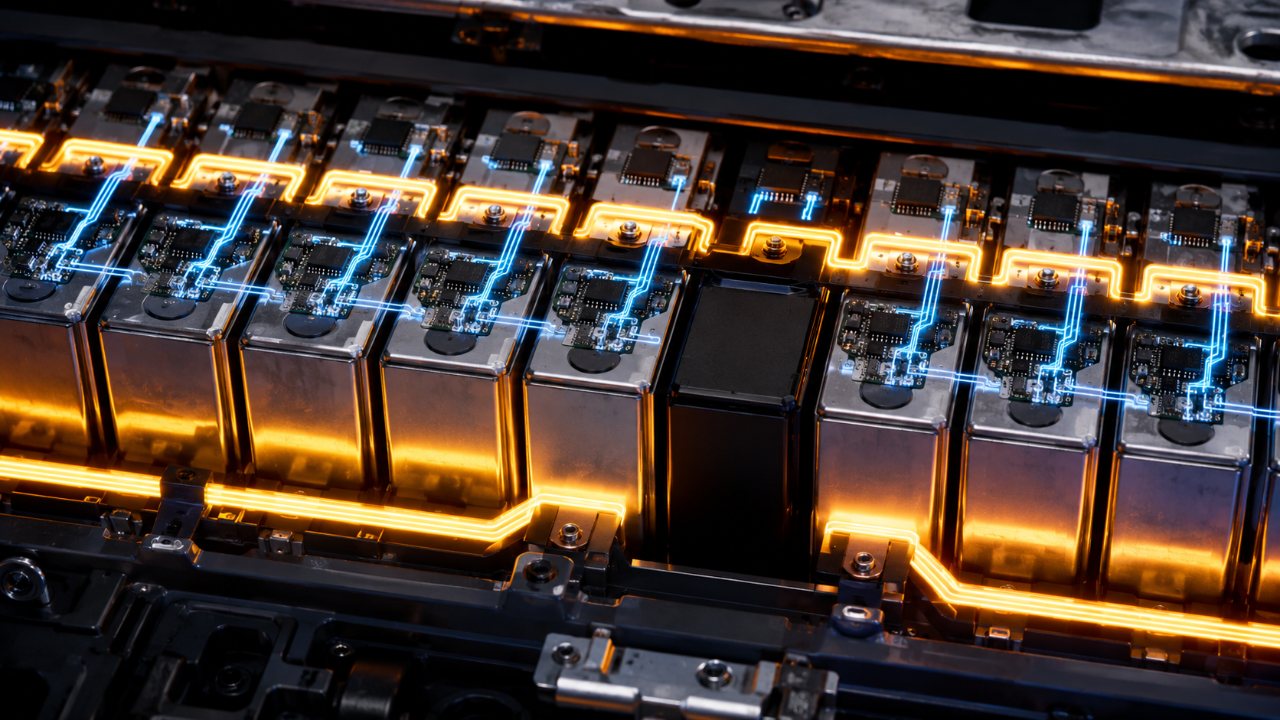
An electric vehicle’s battery pack is only as durable as its weakest cell. Researchers at Chalmers University of Technology in Sweden have modelled what happens when the pack can take that cell out of the circuit, and found it can stay in service for longer before it needs replacing.
The study, published in Nature Communications in October, was led by doctoral student Albert Škegro and Professor Changfu Zou of Chalmers’ Department of Electrical Engineering, with co-authors from PHINIA and Scania.
Why one cell sets the limit
A pack is built from hundreds or thousands of cells connected in series and parallel. No two cells are identical when they leave the factory, and they age at different rates depending on temperature and where they sit in the pack. In a series string, the same current passes through every cell, so the pack must stop discharging when its weakest cell reaches its lower voltage limit, even if the others still hold energy. The same cell reaches its upper limit first when charging. The battery management system can balance the charge between cells, but it cannot make a weak cell hold more.
“Since they are bound to each other, everyone has to keep the same pace as the slowest cell and stop when that cell stops,” says Škegro.
An earlier study co-authored by Zou, published in Nature Energy, found that the weakest cells clearly limit the whole pack.
Switching cells out

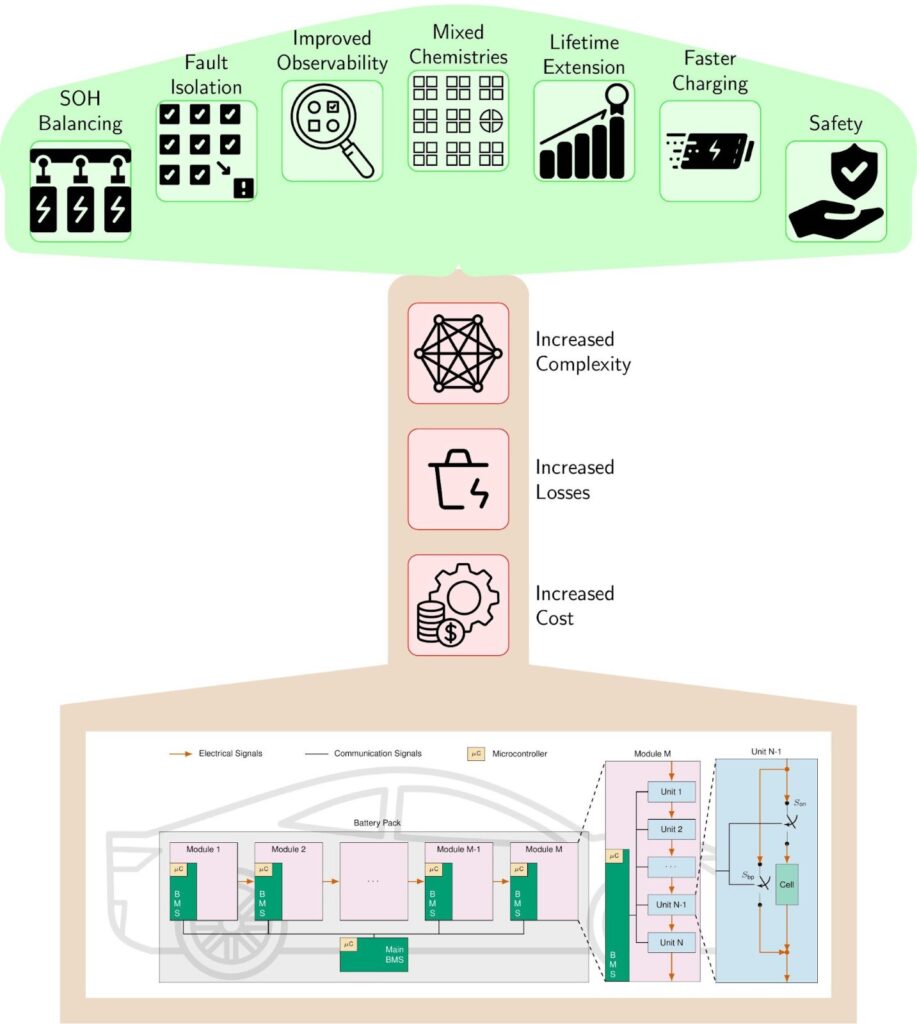
A reconfigurable pack adds switches and control electronics so a weak cell, or a group of cells, can be bypassed while the rest of the pack keeps working.
“With the solution in our study, the battery can instead bypass the cell that is causing problems and continue forward,” Škegro says.
The most capable version gives every cell its own switch. Chalmers describes that as a theoretical upper limit, because manufacturers are more likely to switch groups of cells together, which costs less and delivers less.
“Reconfiguration is not a question of ‘on or off’. It is a spectrum,” says Zou. Where a manufacturer sits on that spectrum decides how much of the benefit it gets.

What the models show
In the best case, with every cell controlled separately, pack life rose by more than 20% in some high-voltage applications, such as electric trucks and long-range cars.
The researchers also modelled an 80kWh car battery covering 12,000km a year. The conventional pack reached its replacement point after 10 years; the reconfigurable pack reached the same point after about 11 years, roughly 14 months later, and was worth more at the end. That is a gain of about 12%, well short of the best case.
The cost is extra electronics in every pack. Chalmers’ own diagram of the concept lists the trade-offs as added complexity, electrical losses, and cost. The authors argue that longer life and a higher residual value outweigh that cost under many realistic conditions. The technology has been tested in research and industrial prototypes, but no manufacturer has put it into a series-production vehicle.
“For a fleet with hundreds of battery packs, extending the battery life can mean significant savings,” says Škegro.
The researchers also expect the approach to reduce how precisely cells must be matched during manufacturing, and to allow more used packs to be reused, for example as stationary energy storage.
How fast packs age now
Fleet telematics company Geotab’s latest study of more than 22,700 EVs across 21 makes and models, published in January, found an average capacity loss of 2.3% a year, up from 1.8% in its 2024 study. Vehicles that relied heavily on DC fast charging above 100kW lost up to 3.0% a year, against about 1.5% for those charged mainly on AC or lower-power chargers.
Battery health already sets the value of a used EV here. Of the roughly 23,000 Nissan Leafs in New Zealand in 2024, most arrived as used imports, and some early 24kWh cars had degraded to a driving range of 50–80km.


