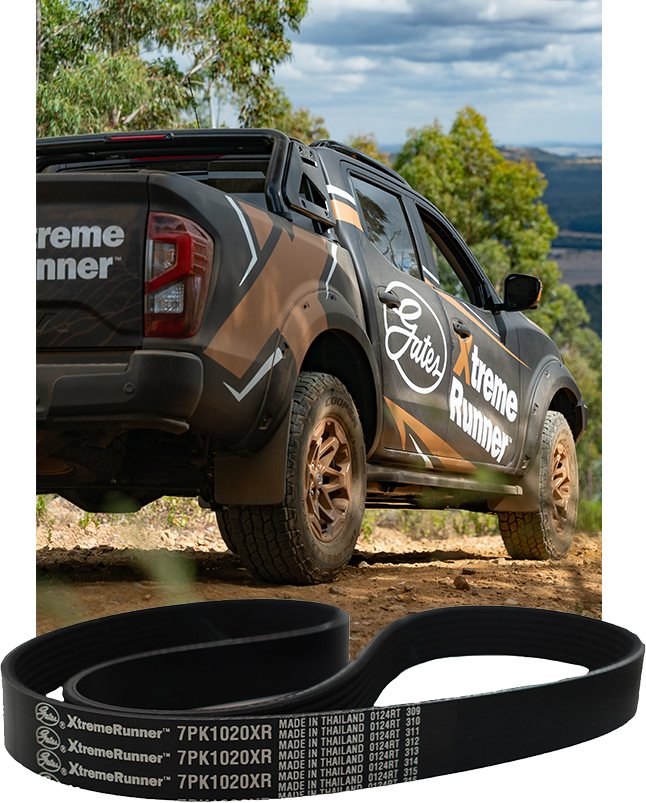
Engines in modern 4WDs are working harder than ever. Increased accessory loads, tighter engine bays, and higher operating temperatures all add stress to the accessory drive, and once a vehicle leaves sealed roads for remote and demanding terrain, a dependable drive belt matters even more.
Gates’ XtremeRunner premium belts are designed for that work. The Micro-V accessory drive belts are aimed at drivers who expect reliable performance on the highway and well beyond it, and they carry a five-year or 100,000km warranty.
Built for harsh conditions
XtremeRunner belts combine an advanced rubber compound with high-strength tensile cords to resist heat, abrasion, stretching, and contamination. Through mud, water crossings, heavy rain, and prolonged exposure to dust, sand, and fine debris, the belt is designed to hold its tension and keep transferring power efficiently, helping prevent slippage and premature wear. The belts are also built to cope with water submersion and excess oil.
The range is designed for vehicles under sustained load: towing, recovery work, extra accessories such as winches and dual-battery systems, and long stretches of off-grid travel. The belts are also engineered to minimise vibration and noise, delivering smooth, stable running throughout their service life and helping protect nearby components.
Fitment and testing
Every XtremeRunner belt is tested to meet or exceed industry standards. Accurate fitment across a broad vehicle range, from everyday passenger cars to 4WDs and performance builds, makes installation straightforward and reduces the risk of comebacks.
Part numbers include 7PK3105XR for the 3.2-litre Ford Ranger PX and Mazda BT-50, 7PK2050XR for the Toyota HiLux from 2015, 7PK1070XR for the Isuzu D-Max and MU-X from 2021, 4PK820XR for the Nissan Navara D40 and Pathfinder R51, and 7PK990XR for the Holden Colorado RC and Rodeo RA. Coverage also extends to the Toyota LandCruiser 70 Series, 200 Series, and Prado, Mitsubishi Triton and Pajero Sport, Nissan Navara D22 and D23 and Patrol Y61, and Jeep Grand Cherokee. Fitment varies with engine and build date, so the full listing in Gates’ NaviGates online catalogue is the place to confirm the right part number.
Checking accessory belts
Gates’ technical guidance is a reminder that modern EPDM belts don’t wear the way older neoprene belts did. Neoprene belts cracked with age, but EPDM belts resist cracking and can run more than 160,000km without visible cracks, wearing instead by losing rib material — and as little as 5% material loss can cause problems.
Rather than looking for cracks, check rib wear with a belt wear gauge pressed gently into the grooves with the engine off; if it rocks from side to side, the belt is due for replacement. Signs of belt slip include reduced engine cooling, inconsistent power steering, poor A/C performance, and a persistent warning light.
Discover XtremeRunner online at gates.com/au/en.html